Who Wrote Which Bar
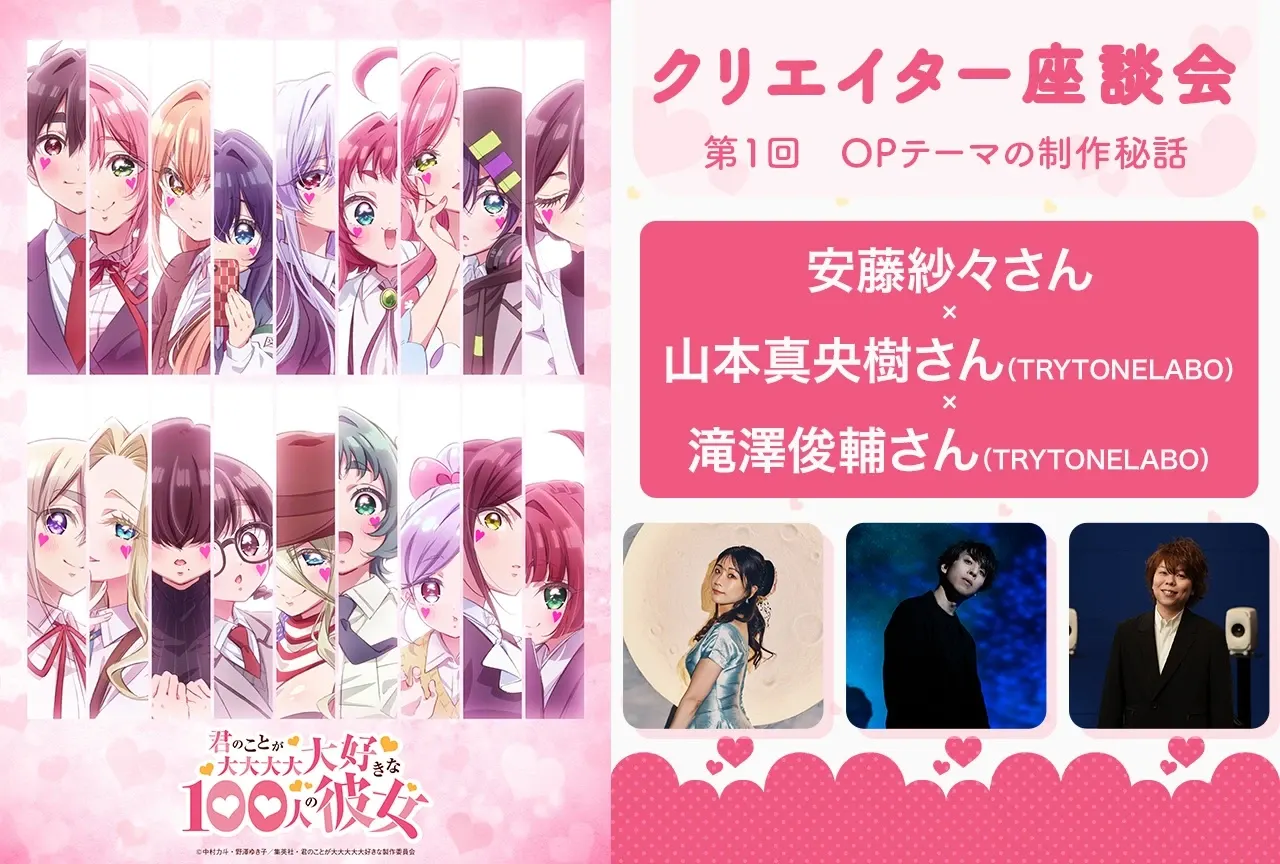
Most anime openings have one composer. This one has three, and none of them wrote a complete song. Yamamoto, one of the song's three composers, laid out the split for Japanese anime news site Animate Times, and it reads like a relay baton order.
Tomoya Tabuchi (bassist of UNISON SQUARE GARDEN), who is credited on the song but did not join the interview, came up with the chorus melody, the intro, and the lead-in to the first verse. Yamamoto wrote the chord progression and arrangement for those parts, then wrote the verse melody and arrangement himself. He passed that to Takizawa, his colleague in TRYTONELABO, who wrote the pre-chorus and reworked the chords under Tabuchi's chorus melody.
From there it keeps bouncing. Yamamoto handled the interlude through the bridge and the second-verse melody, but Takizawa wrote the chords for it and then kept going through the guitar solo. Tabuchi took the quiet breakdown chorus. Takizawa wrote the chords for the big chorus that follows. Yamamoto wrote the melody and chords for the closing "LALALA" section, and Takizawa finished with the outro.
On the arrangement side, the division was simpler: Yamamoto did the electronic sounds and Takizawa the acoustic instruments.
All of it happened over LINE, the messaging app that is Japan's default group chat. Yamamoto described the workflow as sending a file labeled "verse done" and waiting for the next person to add a pre-chorus. The ending theme, "Kitare Koi Itare Ai," was being built in the same group at the same time, so a rough ED file would occasionally land in the chat and, per Takizawa, give the OP team fresh ideas. He said this is how they have always worked.
Yamamoto said the fun of the format is not having to plan ahead. His verse ends on a key change with no blueprint for what comes next, something he would never do when writing alone. He handed it off assuming Takizawa would sort it out. Takizawa said he did, if only because he refused to make a good hand-off worse.
That trust has a history. Takizawa worked on the Season 1 opening "Dai Dai Dai Dai Daisuki na Kimi e♡" and the Season 2 opening "Arigato, Daisuki ni Natte Kurete," and somewhere in those exchanges with Tabuchi he became known as the guy who can modulate into any key and find his way back. He said he now feels obligated to live up to it.
Writing Lyrics for a Song With That Many Sections
The interviewer half-joked about losing count of how many distinct sections the song has. Andō, the song's lyricist, said the opening was harder to write than the ending, which surprised Takizawa. With so many sections, the usual trick of dipping in the pre-chorus and exploding in the chorus stopped working, and the key change at the end of the verse left her unsure what the pre-chorus should even say. She spent a long time on the structure.
Takizawa had no such worries going in. He pointed to her Season 2 lyric "Eternal Daishukkiss" as proof that she has the kind of sensibility needed to keep up with the manga's energy. Yamamoto felt the same after seeing her lyrics for the insert song "HAKOBUNE 100-nin Nottemo Daijōbu," and said he trusted her to handle the song's odd syllable placements.
Andō's own favorite line is "Kono ai wa Guinness! Kokumin Eiyo Shō!" (roughly, "This love is a Guinness record! A People's Honor Award!"). She also worked in "nehan," the Buddhist word for nirvana, as a nod to how god-like Rentarō is, and a phrase she rendered as "Genesis of Daisuki." She said the arrangement is impossible to sing solo and praised the voice cast's diction, while Yamamoto said the song changed character once the cast's vocals replaced the demo track.
The song is credited to Rentarō Family, the ensemble name for the show's heroine voice cast. According to the official site's announcement, all of the heroines sing on both the opening and ending.
The Single and the Season It Belongs To
The single "Daisuki♡Zutto Eien ni♡ / Kitare Koi Itare Ai" came out from Lantis on September 9, 2026 for ¥2,750. It has eight tracks: the opening, the ending, the insert songs "Kyun-chi♡!" and "HAKOBUNE 100-nin Nottemo Daijōbu" (the latter played in Season 3's fourth episode, episode 28 overall), and instrumental versions of all four. Andō pointed out that the instrumentals mean school bands can cover the songs at culture festivals.
Season 3 of 100 Girlfriends aired from July 5 to September 20, 2026 on Tokyo MX and other stations, running 12 episodes. Bibury Animation Studios produced it with Hikaru Satō directing, Takashi Aoshima on series composition, and Akane Yano on character design. Wataru Katō voices Rentarō, with Kaede Hondo and Miyu Tomita as Hakari and Karane, the first two girlfriends.
The manga by Rikito Nakamura and Yukiko Nozawa runs in Shueisha's Weekly Young Jump. Rentarō, rejected 100 times in middle school, learns from the God of Love that he has 100 soulmates in high school, and that anyone who meets a soulmate and fails to find happiness with them dies. All three creators said the premise caught them off guard: Andō with how sincere the confession scenes are, Takizawa with how Rentarō's devotion holds up as the girlfriend count climbs, and Yamamoto with how distinctly each heroine is written when most romantic comedies stop at five.
Looking Ahead
Season 3 streamed on Crunchyroll worldwide with English subtitles and an English dub, so the full run including the September 20 finale is available now. No fourth season has been announced.
The manga is published in English by Seven Seas Entertainment, which has volumes scheduled through early 2027.
Animate Times published a companion interview the same day with the ending theme's creators, covering the minute-plus guitar battle in "Kitare Koi Itare Ai." Given that Takizawa and Yamamoto both admitted the ending made their own song feel tame by comparison, that one is worth a read too.