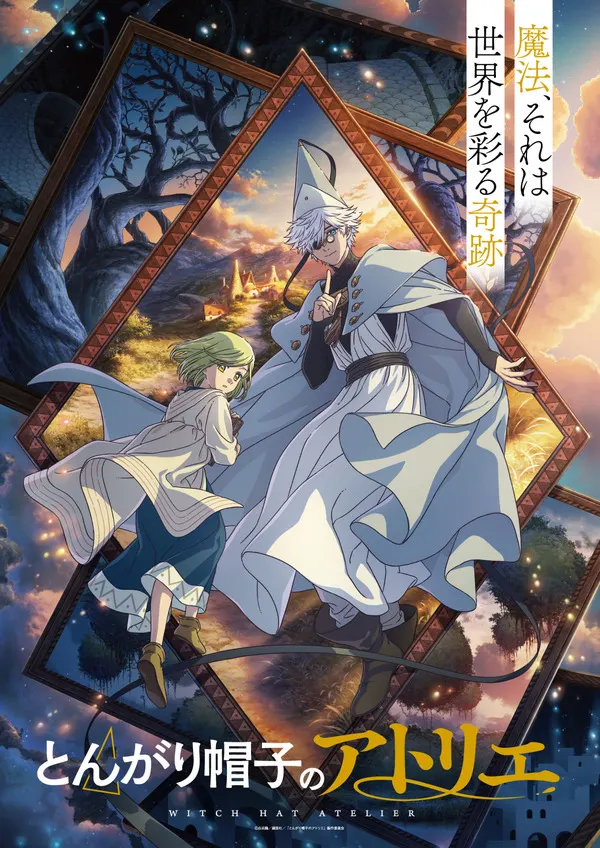
A Manga With International Pedigree
Kamome Shirahama's Witch Hat Atelier manga, serialized in Kodansha's Morning Two magazine, had already built a loyal global readership before the anime aired a single frame. The series has won manga awards in Spain, the United States, and South Korea, and Shirahama's intricate pen-and-ink linework is held in near-reverent esteem in Western comic circles. A feature on Japanese anime news site Anime Anime describes overseas readers treating her art as "the pinnacle of artistic achievement."
With that kind of international demand already in place, the production committee went all-in on distribution. The team partnered with Crunchyroll for worldwide simultaneous streaming and, in a rare move for a TV anime, arranged a same-day English dub. The result: the show is sitting at the top of major overseas ranking sites across the board, and English-language search volume appears to be several times higher than Japan's domestic figures.
The anime is directed by Ayumu Watanabe, whose credits include the award-winning film Children of the Sea. Hiroshi Seko (Attack on Titan, Vinland Saga, Mob Psycho 100) handles series composition, with animation production by BUG FILMS.
A Magic System Built for Western Fantasy Fans
Magic in Witch Hat Atelier runs on knowledge, not bloodlines. Spells are cast by drawing specific patterns with pen and ink, meaning anyone with the skill and study can learn them. That premise fits naturally into Western fantasy traditions where mastery comes from effort and intellect rather than inherited power.
The Anime Anime piece points to the show's refusal to take shortcuts as central to its overseas appeal. Protagonist Coco's journey isn't just a cheerful coming-of-age story. The series confronts questions about a magic user's responsibilities and the costs of forbidden knowledge, giving adult viewers a reason to stay invested.
The supporting cast follows the same philosophy. Agott's stubborn pride, Tetia's struggle to master her own magic, and Richeh's pursuit of an ideal are treated as genuine internal conflicts rather than surface-level character quirks. Overseas forums praise the adaptation for maintaining the manga's deliberate pacing, with fans calling it "a moving painting" rather than a rush through plot milestones.
The Qifrey Scene That Drew Gojo Comparisons
Episode 5 turned Qifrey, Coco's enigmatic mentor, into a viral sensation. His massive water-magic display to shield his apprentices from a giant scaled dragon lit up social media, with fans immediately drawing parallels to Satoru Gojo's Hollow Purple from Jujutsu Kaisen.
The comparisons go beyond raw power. White hair, one eye hidden, a casual warmth that snaps into devastating intensity when his students are in danger: the overlap is hard to miss. Natsuki Hanae (Tanjirō Kamado in Demon Slayer) voices Qifrey, bringing quiet authority to the role. And in a detail JJK fans picked up on fast, Yūichi Nakamura, the voice of Gojo himself, is already in the Witch Hat Atelier cast as Olruggio, Qifrey's fellow sorcerer.
Looking Ahead
Witch Hat Atelier airs Mondays at 23:00 on TOKYO MX and other channels in Japan, with global simulcast streaming on Crunchyroll, including the simultaneous English dub. Netflix and ABEMA also carry the series domestically. The opening theme, "Kaze no Anthem feat. suis from Yorushika" by Eve, and the ending theme by Nakamura Hak are both streaming now.
For fans who want to explore the source material, Kodansha USA publishes the manga in English under its original title, Witch Hat Atelier. The series remains ongoing in Morning Two.